Back when the idea of an elected school board was still being debated, opponents voiced fears that the powerful Chicago Teachers Union would simply try to buy the elections.
Yet as Chicago stands on a historic precipice of electing all 20 members and a citywide president on Nov. 3 that’s not how it’s playing out.
Cash is flooding the election but the bulk so far has come from wealthy, often suburban donors, whose political groups have outraised the CTU 5:1 and outspent the teachers union nearly 3:1, according to an analysis of the most recent campaign finance filings between Oct. 1, 2025, and Oct. 15, 2026.
Charter school backers and a few prominent billionaires aligned in a shared antipathy for the teachers union have aimed their millions attacking the Chicago Teacher Union’s choice for board president rather than at bolstering any particular candidate, the Sun-Times/WBEZ analysis shows.
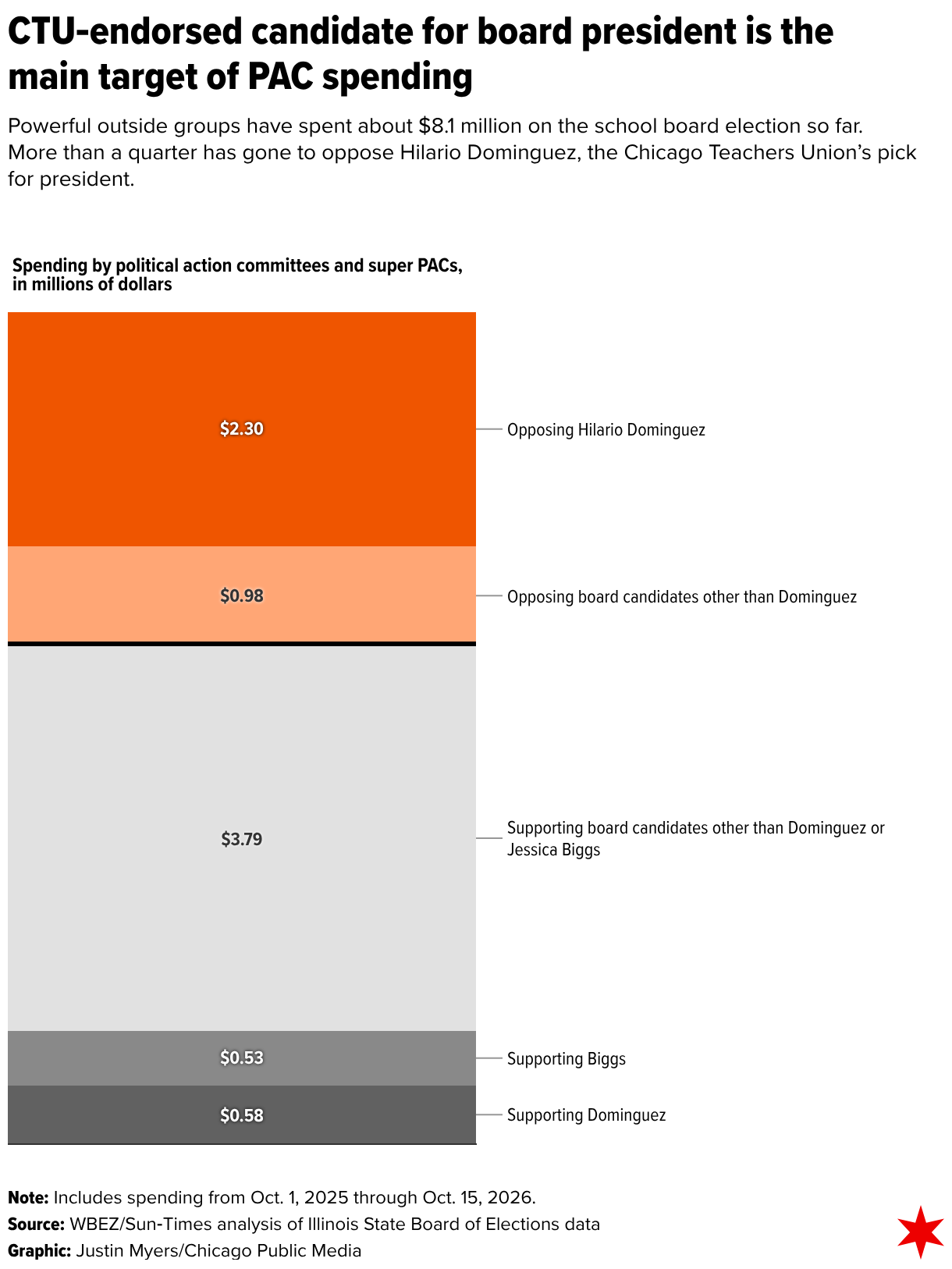
More than a quarter of the $8.1 million total spent on all races so far by these political action committees and the independent expenditure committees, known as super PACs, has targeted a single candidate: Hilario Dominguez.
The spending to oppose Dominguez is more than four times the amount spent on the top supported candidate, Jessica Biggs, one of the other two candidates for school board president.
Biggs, a former CPS principal, has attracted wide-ranging contributions from labor unions other than the CTU, former CPS leaders and investment bankers and CEOs — such as Michael Sacks of GCM Grosvenor and Paul Finnegan of Madison Dearborn Partners.
Both Biggs and Dominguez have directly raised about $1 million. Defense attorney Victor Henderson, who lent himself $500,000, trails in fundraising with no support from special interest groups, unions or PACs — something he touts.
Arnie Rivera, CPS former chief operating officer who heads a new advocacy group called the Chicago Education Alliance, said the billionaire-funded political groups see the school board races as an opportunity to take down the CTU before the mayoral race in February. Mayor Brandon Johnson remains closely allied with the union, which helped catapult their former organizer to office. Some of the $12.7 million raised by three education-focused political action committees spending big will almost certainly be deployed in the mayor’s race.
“It just becomes a proxy battle on the political side,” Rivera said. “CTU is a huge political group here in the city, and I think you have people who are trying to push back on it. I think that is what it comes down to.”
The latest campaign finance reports from the Illinois State Board of Elections, which were due by midnight Thursday, show an escalation of cash and spending in the last three months, both directly by the campaigns, as well as by outside groups on their behalf.
The 43 total candidates vying for board seats have directly raised another $4.1 million since the end of June, adding up to $5.9 million in contributions since October 2025. Since August, four candidates have withdrawn. There are also four write-in candidates.
Candidates just for the board president position account for $3.5 million, including contributions for two who recently dropped out.
Twenty local district races, 15 of which are contested, split the remaining $2.4 million. Eleven races have accumulated more than $100,000, with one competitive Northwest Side race in District 1b pulling in $292,062 in contributions.
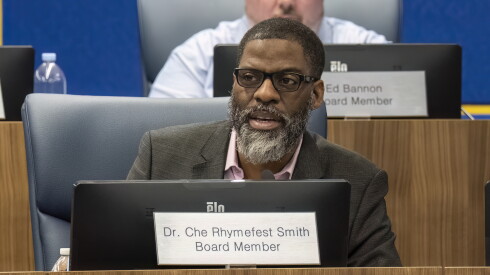
None of the five district candidates running unopposed is aligned with the CTU. Current school board members Che “Rhymefest” Smith and Ellen Rosenfeld have raised $100,000 each.
“I'm open to taking money from anybody,” Smith said, noting that he also has gotten donations from SEIU, the union that represents support staff in CPS. “But I'll tell you one thing that's interesting: They never asked me to vote a certain way. They never have given a policy and said, ‘Push that through.’ ”
The real money in these races is being raised and spent outside the campaigns via a series of political action committees and super PACs. The latter face no limits on how much they can raise or spend, as long as they don’t coordinate with candidates.
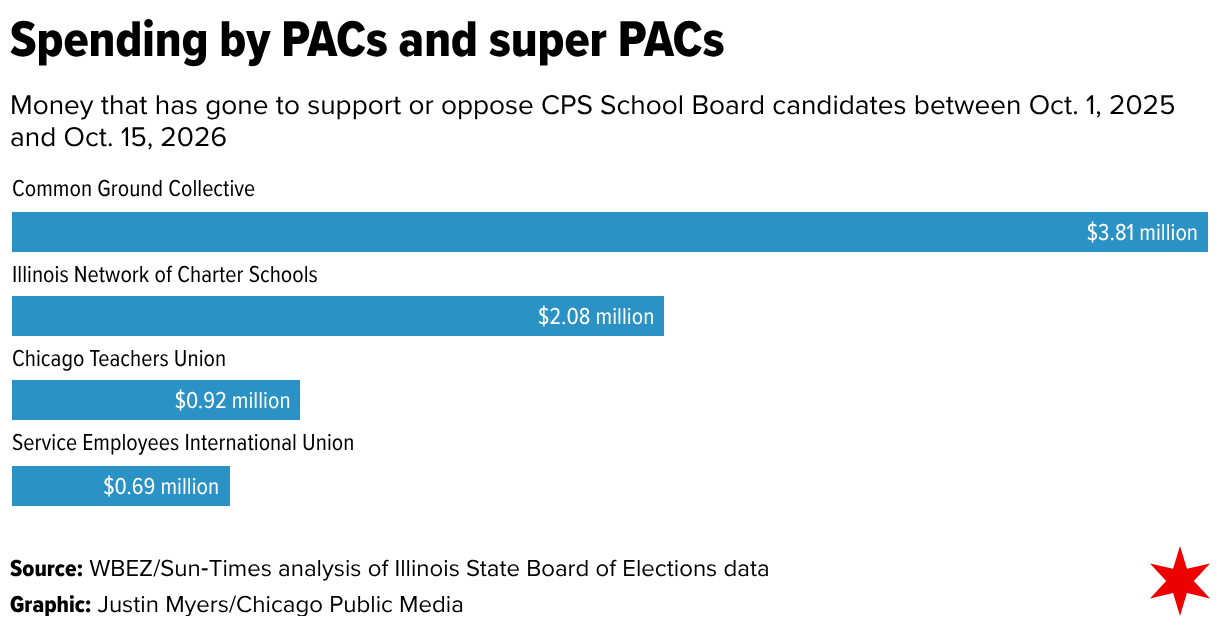
In addition to wealthy charter school supporters who typically amass and spend when school issues are at stake, billionaire Sacks has dropped millions attacking the Chicago Teachers Union candidates via his newly formed Common Ground Collective super PAC.
That group has spent the most so far, $3.7 million on digital ads and production, about half of it attacking Dominguez, a teacher-turned-CTU deputy political director.
The group has yet to endorse or fund ads in support of anyone for board president, though Sacks himself gave $400,000 to Biggs.
A key behind-the-scenes ally to former Mayor Rahm Emanuel — who long fought with the CTU — Sacks has given the most money to any of the groups funding the school board elections, $5.5 million as of Oct. 15.
Close on his heels with $3.8 million is Jim Frank, a retired executive from Winnetka and regular major donor to the Illinois Network of Charter Schools political spending groups.
The INCS Action super PAC has spent $450,000 on a digital ad opposing Dominguez, but only $1,000 supporting one candidate for president who has since dropped out. INCS' political arms have not made any endorsements for president.
Outspent by the CTU in 2024, the INCS Action groups have also spent an additional $1.7 million supporting 19 candidates currently in board races, including to candidates who face no opponent.
Representatives from Common Ground Collective and INCS declined interview requests.
Dominguez said money isn’t everything.
“What I'll say is this — that we didn't go from mayoral control to go to billionaire control, right?” Dominguez said. “At no point in this race did we think we were going to be beating billionaires in spending money. One thing that we've seen and we're seeing across the entire country is that organized people beats organized money any day of the week.”
The third group aligned in this election against the teachers union is The Urban Center, though its donations and spending are dwarfed by INCS and the Common Ground Collective.
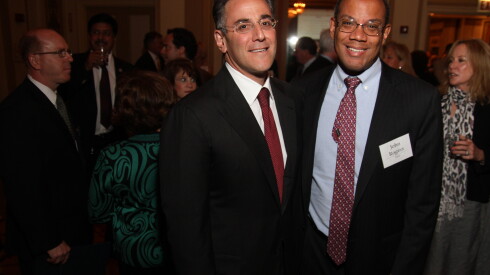
Juan Rangel, executive director of the center, which promotes school choice across public and private schools, said to make an impact you need to spend big money. That requires first educating people that a school board race is happening and explaining what’s at stake.
“I would hope that people would understand that these school board elections are the most important races on the November ballot, and they will have implications and ramifications to the February mayoral election," Rangel said.
What’s different about Chicago is that the wealthy billionaires are local, rather than outsiders pushing a conservative agenda, said Jeffrey R. Henig, a professor emeritus at Columbia University's Teachers College, who co-wrote the book, “Outside Money in School Board Elections: The Nationalization of Education Politics.”
“I'm struck by … the lack of sharp ideological cleavages and the relative absence of the culture war politics that you see in a lot of suburban districts,” he said. For example, no one is pushing book bans.
He also points out differences between candidates are more subtle than in ones where big national social issues are at play, so “instead of eliminating charter schools in Chicago, it's about how and under what extreme circumstances we might close some schools.”
Teacher unions usually enjoy a built-in advantage, regardless of money, Henig said. That’s because teachers and parents with a vested interest in what happens in schools are the most likely to show up and actually vote in school board elections.
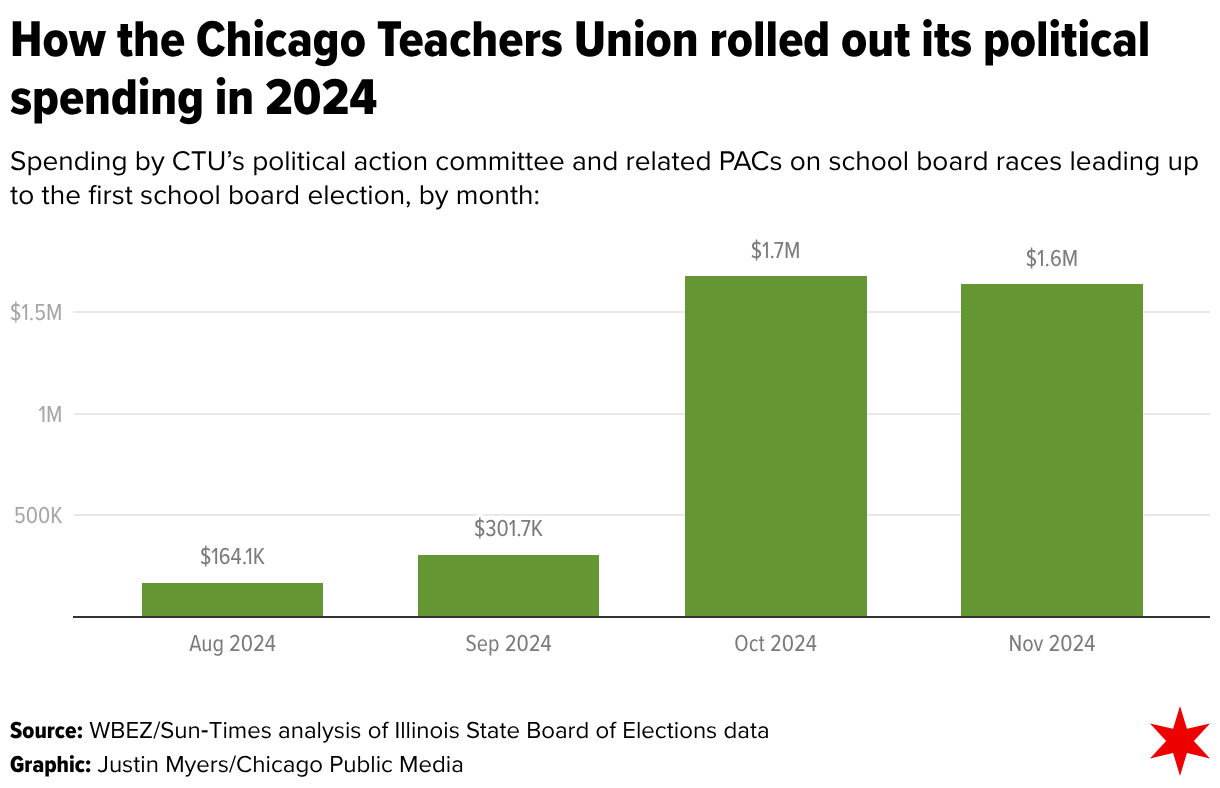
The CTU ended up outspending everyone else two years ago — $4.3 million via two political action committees, with about half dropping in the last month.
It’s been slower so far this time in unrolling campaign ads.
The CTU has disclosed raising about $2.5 million and spent about $2.2 million through its political organization as well as Our Schools PAC, which it funds.
“What is unusual in spending in a race is spending a tremendous amount of money not for somebody for president but against somebody,” said CTU Pavlyn Jankov, the union’s research director.
“We’re never going to compete with the billionaires in this race, and our members support our candidates, so we're going to be continuing to put our money into this race because it reflects the values of 30,000 members.”
More contributions and spending still could come. Like most labor unions, its coffers get replenished through member dues. CTU leaders tried in vain last spring to get members to increase dues, which could have gone toward political spending.
Robert Bruno, director of the University of Illinois Urbana-Champaign’s labor education department and author of a book about the 2012 CTU strike, said the union’s resources have been stretched lately by lawsuits as well as federal probes — and other elections.
“I can't help but also acknowledge that in addition to this first-ever school board race, there's also the mayoral race, and there's a lot of competition. And that competition involves candidates who have raised a fair amount of money, can raise a lot of money, and obviously, if Mayor Johnson's going to get reelected, he's going to need a very, very highly engaged and supportive Chicago Teachers Union.”
Plus, he notes, Biggs is no enemy to labor, squarely backed by SEIU.
Another factor in this election is that the SEIU, the union that represents support staff, has split from its once-close ally, the CTU, after accusing the teachers union of trying to raid some of its members. And they’ve split on most of their candidate endorsements, parting ways on 10 endorsements, including board president. They only overlap on five endorsements.
But Anthony Driver, chair of a new SEIU-funded PAC Brighter Futures, warned against lumping his union with the other political groups that are anti-CTU.
“We are not a corporate PAC,” he said. “If anything, we are a PAC that operates similarly to the CTU.”
“We represent low-wage workers who are largely erased,” he said, “and it becomes a question of who gets to be heard.”

Chicago School Board president candidate Jessica Biggs speaks Wednesday with Gwendolyn Brooks College Prep high school students after a candidate forum at the WBEZ and the Chicago Sun-Times newsroom at Navy Pier. She is being backed by a wide range of supporters, including SEIU.
Zubaer Khan/Sun-Times
Driver said his members chose to endorse Biggs for president because they believed in her platform — hardly to spite the CTU. That’s the same for individual school board candidates like Carlos Rivas Jr. and Che “Rhymefest” Smith.
“They have stood with us,” Driver said.
He also pointed out that union PACs have a finite amount of money, and so hold their spending until the last few weeks of an election, whereas PACs supported by corporate backers have more resources so can maintain high spending throughout.
Driver also noted that SEIU is only spending to support candidates, not oppose them.
Henig said it is not unusual for unions supporting teachers and school district support staff to support different candidates. After all, when it comes to budget cuts, they do not have the same interests.
Chicago was the outlier, Driver said, which is ”what made us able to build power.”